
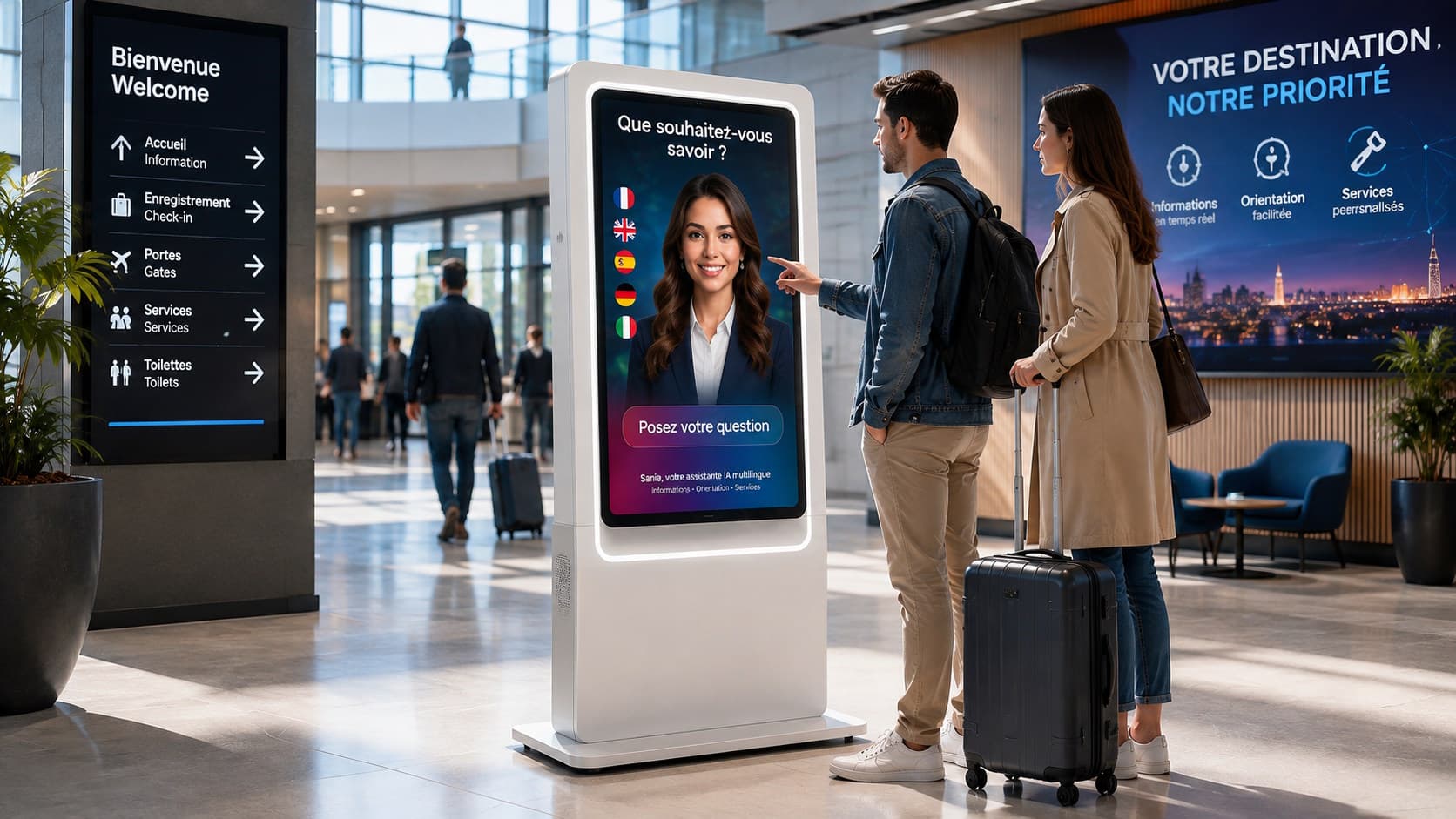
Introduction: the operational challenge
Deploying a vocal AI avatar on a kiosk or screen in a public venue brings concrete technical constraints: variable ambient noise, multilingual users, 24/7 availability and privacy requirements. This guide sets out an operational approach to make pragmatic decisions about ASR selection, audio hardware, preprocessing pipeline and validation and operations practices.
The objective is not to offer a one‑size‑fits‑all solution, but to present the trade-offs to evaluate according to the environment profile and business goals, and to deliver checklists and runbooks usable by project leads, IT managers and integrators.
Why this choice is critical
Voice recognition quality determines the usability of the vocal interface. In quiet environments, most modern ASR engines perform satisfactorily. In noisy settings, degradation stems as much from acoustics and microphone placement as from the ASR engine limits.
Technical choices also have non‑functional impacts: latency, audio stream privacy, operational cost and maintenance burden. Design must therefore be treated as a dependent chain of elements: audio sensors, edge processing, transport to a recognition service, and fallback UX.
ASR decision matrix: edge vs cloud
The first strategic choice is where the ASR engine runs. Cloud processing tends to provide better recognition performance and faster model updates, while edge solutions reduce latency and limit sending audio streams to third parties. The right choice depends on noise profile, privacy requirements and network constraints.
For sites with reliable connectivity and tolerable privacy constraints, cloud simplifies language handling and scalable engines. For sites with strict latency needs, limited bandwidth or strong privacy requirements, edge ASR may be preferred with an adapted configuration.
In practice, a hybrid architecture often makes sense: local preprocessing and voice activity detection (VAD), with routing to a cloud or edge ASR depending on context and privacy policies. The technical decision should be formalized in the specifications and network SLAs.
Microphones and placement: mono, arrays and mounting
The sensor choice is as decisive as the ASR engine. Directional single microphones can be sufficient in quiet spaces, while microphone arrays enable advanced spatial processing and beamforming that significantly improve the signal‑to‑noise ratio perceived by the ASR.
Physical placement influences capture: height, distance to the user, obstructions and reflective surfaces are factors to consider when installing. Kiosk design and touch ergonomics must be planned together with microphone placement to avoid acoustic dead zones.
Consider a microphone array for noisy sites to enable beamforming and echo cancellation depending on the hardware.
Prefer placement close to the interaction zone, with clear visual marking to encourage speaking toward the sensor.
Avoid locations near recurring noise sources (cash registers, extractors, automatic doors).
Audio preprocessing pipeline: VAD, noise reduction and beamforming
Before reaching the ASR, the audio chain should apply several processing steps to improve the useful signal. Voice activity detection (VAD) avoids sending continuous noise to the engine and helps control latency. Adaptive noise suppression and band filters help stabilize the signal.
Beamforming uses a microphone array to favor the user’s voice direction and attenuate off‑axis sounds. Depending on hardware, these processes can run locally (edge) or in the cloud. It is recommended to architect the chain so that critical components (VAD, echo cancellation) remain available even during connectivity loss.
Wake word, VAD and handling accidental activations
Combining a wake word with VAD improves ergonomics: a well‑chosen wake word allows active listening without constantly capturing the audio stream. The wake word can run locally for privacy and responsiveness, while VAD manages session opening.
UX behaviors must be planned to reduce accidental triggers in noisy environments: short visual/audio feedback upon activation, a tactile start option and a visible or physical mic mute according to the project.
Language detection and multilingual strategy
Automatic language detection eases multilingual greetings, but it can be disturbed by noise and short utterances. Two complementary approaches are recommended: offer an explicit language choice via the touch interface at the start, and use automatic detection as an aid when the vocal signal is long and stable enough.
In all cases, favor a multimodal UX: display available languages, allow quick tactile language switching and ensure business knowledge bases are up to date in relevant languages. SANIA can communicate in more than 100 languages depending on configuration, which helps implementation when the ASR infrastructure supports target languages.
Tactile fallback and multimodal experience
No voice system is infallible in all circumstances. Providing a tactile or visual fallback is essential to maintain service access. For example, if the ASR confidence is low or repeated activity detection fails, the interface must clearly offer a tactile option to continue the task.
The UX should make voice‑to‑touch transitions smooth: suggestion buttons, contextual menus and prefilled shortcuts reduce cognitive load. The avatar persona can guide the user toward these alternatives without interrupting the experience.
On‑site testing protocols
Lab tests are not enough: validate the voice chain on site, during real occupancy hours and with native speakers of target languages. Build representative scenario sets (typical questions, accents, utterance durations) and record interactions for qualitative analysis and remediation.
Tests must cover network resilience, latency, wake‑word false trigger rates and sudden noise events. Results will guide audio pipeline calibration, the edge/cloud choice and VAD sensitivity settings.
Maintenance and 24/7 runbook: operational checklist
Reliable operation requires clear maintenance procedures accessible to local teams or providers. The runbook should describe regular checks, emergency actions and monitoring operations to ensure continuous availability.
Favor simple, repeatable procedures and provide remote diagnostic means according to configuration. Software component updates (audio drivers, kiosk firmware, preprocessing modules) must be planned and tracked.
Visual inspection and cleaning of microphone grills and speakers.
Verify network and power connections before intervening on the ASR.
Check local logs and extract audio traces periodically when privacy policy allows.
Verify software versions and apply controlled patches.
Procedure to switch to tactile mode if an audio incident persists.
Typical configurations by noise level
To help decision‑making, here are practical orientations by acoustic profile. These remain general recommendations to adapt to context.
Low noise: a vocal interface with a directional mic and cloud ASR is acceptable. Preprocessing can be minimal and UX may favor voice as the primary input.
Medium noise: a microphone array with beamforming, local VAD and adaptive noise suppression improves robustness. A hybrid architecture (local preprocessing, cloud or edge ASR) is often appropriate.
High noise: favor a quality sensor (array), advanced local processing, wake word at the edge and a systematic tactile fallback strategy. Privacy concerns may also recommend local processing of sensitive segments before any sending.
Short FAQ
Q: Should we always choose a microphone array for noisy venues? A: An array brings technical benefits (beamforming) but adds hardware cost and tighter integration. It is often the most effective solution for noisy environments, but the decision must be justified by expected usage and project budget.
Q: How to measure that voice recognition is sufficient to accept a deployment? A: Beyond technical measures, define clear acceptance criteria in your specifications and validate on site with representative scenarios. Criteria should include perceivable failure rates, interaction latency and users’ ability to complete their goals via voice or the tactile fallback.