
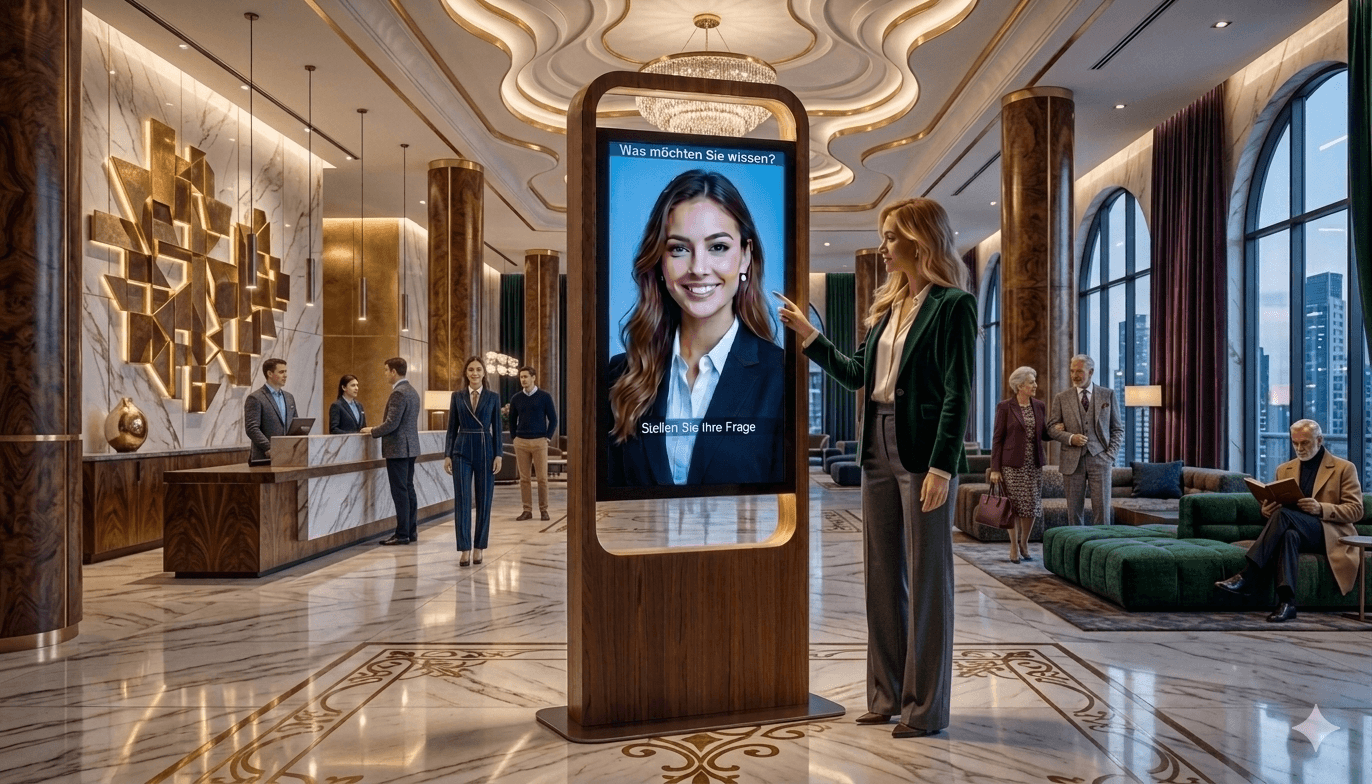
Why multilingual reception matters
Public buildings welcome diverse audiences: tourists, foreign residents and non-native speakers. Providing clear information in multiple languages increases accessibility and reduces queues.
A multilingual AI avatar for reception can offer 24/7 conversational guidance on procedures, directions and schedules, improving service availability without increasing front-desk staffing.
Concrete benefits for town halls and tourism offices
An avatar deployed on screens or kiosks can answer common questions in visitors' languages using an organization-specific knowledge base. It can explain procedures, provide maps and list events.
Note that some actions require integrations: the avatar can direct visitors to an online ticketing service or, when a specific integration exists, interact with booking systems. Integrations must be planned and secured.
Technical and operational selection criteria
Languages and quality: choose a solution covering the languages your audience needs, and assess the quality of spoken and written outputs.
Knowledge management: prefer solutions that let you import and update institutional content so answers reflect your organization’s information.
Hardware and compatibility: ensure the avatar runs on your existing screens and kiosks, supports touch interaction and is suited for continuous public use.
Operational considerations and security
Escalation paths: define how the avatar transfers complex queries to human agents to maintain service continuity.
Data exchanges and integrations: when connecting to internal systems, plan data flows according to your security policies. Features like payments or CRM access require specific integrations.
LLM choices: multiple language models can be employed. Review traceability, knowledge grounding and moderation options when selecting engines.
FAQ
Which languages are supported? A multilingual AI avatar can cover over 100 languages, but prioritize those most relevant to your visitors.
Will it replace staff? The avatar increases information availability and handles routine questions; human agents remain essential for complex cases.
Can it access internal systems? It can point users to services and, with dedicated integrations, interact with certain systems. Integrations must be designed as part of the project.