
Introduction
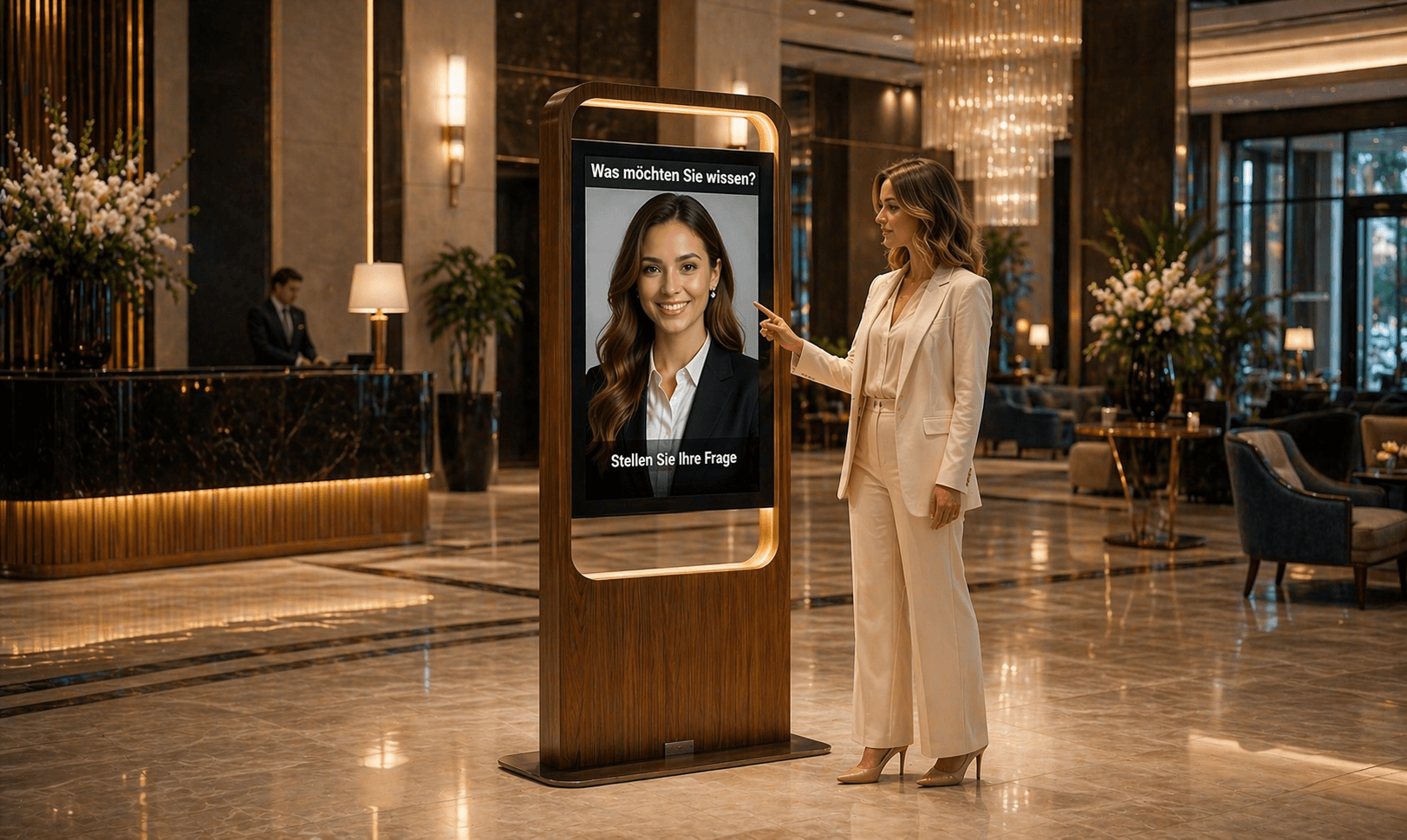
Installing an AI avatar on a screen or kiosk in a hotel raises concrete questions: which services to offer guests, how to keep information reliable, and where to position the screen so it is used while respecting guests’ privacy. This guide aims to help hotel teams and decision-makers prepare a deployment that is useful and operational, while staying pragmatic about the capabilities and limits of the technology.
Priority use cases for a hotel
Before any rollout, it is essential to define the uses that will bring value to both guests and staff. Among common and easily achievable cases without complex integrations are reception information (opening hours, hotel services), directions to spaces (restaurants, spa, gym), presentation of paid services and associated conditions, local information (transport, points of interest), answers to practical questions (Wi‑Fi connection, safety instructions), and multilingual assistance for international guests.
Define the functional scope and limits
An AI avatar project must clearly distinguish what the avatar can handle directly and what requires a human intervention or a specific integration. For example, pointing someone to an online booking is possible, but executing a reservation, a payment or a full check-in requires additional connections and processes. It is therefore recommended to define from the start: the topics handled by the avatar, the topics to redirect to reception or the relevant service, and template phrasings that invite the visitor to contact staff when the situation exceeds the defined scope. This clarification limits expectations and facilitates team training.
Prepare the knowledge base: content, responsibility and updates
The quality of responses depends essentially on the business information provided. For a hotel, the knowledge base should combine different types of content: service sheets (breakfast, room service, spa), practical information (Wi‑Fi access, shuttle schedules), local resources (access maps, cultural recommendations) and internal procedures (baggage policy, late arrival hours).
It is important to assign editorial responsibles for each content family. These contacts validate information and organise updates according to internal processes. Dated contents should display a version or last‑validated date to avoid distributing obsolete information.
On the language question, the SANIA avatar can communicate in more than 100 languages. Rather than systematically translating the entire base, a pragmatic approach is to prioritise the languages that are actually relevant to the hotel’s clientele and to verify the quality of translations for sensitive information (service conditions, safety rules).
Placement and ergonomics in a hotel context
The choice of placement strongly influences use and acceptance. A screen located in the lobby can be visible to everyone but must respect confidentiality of conversations and the flow of people. Conversely, a kiosk placed near the concierge desk encourages service‑oriented interactions but may get fewer spontaneous visitors.
Beyond placement, the interface must take the sound environment and readability into account: legible text, tactile alternatives if voice interaction is limited by noise, and discreet interaction options for guests who prefer to read. Accessibility must be considered in relation to guests’ specific needs, keeping in mind that accessibility also depends on the chosen hardware and installation.
Running an operational pilot: objectives and qualitative methods
A well‑designed pilot makes it possible to validate the service’s usefulness without generalising to all properties. Rather than imposing standard indicators, it is preferable to define operational objectives adapted to the hotel: improve access to information outside reception, ease the welcome of non‑native speakers, or free staff time on repetitive requests.
Pilot management methods should favour qualitative measures and field feedback: observations of interactions, interviews with reception and concierge, independent guest questionnaires and tracking of reported incidents. These approaches make it possible to quickly identify missing contents, ambiguous phrasings and ergonomic problems. Note that feedback collection must comply with internal confidentiality rules and, where applicable, with applicable regulations.
Frequent mistakes and points of vigilance
Several mistakes can compromise the usefulness of an AI avatar in a hotel. A first mistake is assigning too many technical tasks to the avatar without planning the necessary integrations; this creates frustration when the avatar cannot complete an action. Another mistake is neglecting editorial governance: obsolete information, inconsistencies between services or lack of a responsible person to validate updates undermines guest trust.
Listening and sound environment issues are also frequent: a voice interaction that is not adapted or poorly calibrated in a noisy lobby reduces usage. Finally, not involving teams in the system’s arrival exposes the project to internal resistance and prevents reporting of practical problems. Planning information sessions for staff facilitates adoption.
Operational checklist before deployment
The following checklist summarises the concrete steps to validate before activating an AI avatar in a hotel.
Define priority use cases and the limits of the functional scope
Identify editorial responsibles for each content family
Prepare and validate service sheets and practical information (hours, rates, conditions)
Decide on priority languages and the quality of translations
Choose the placement and check lighting and acoustic conditions
Plan an internal communication plan to train staff on usage and on scenarios for directing guests to human teams where appropriate, without assuming an automatic transfer of conversations to a human agent. (Note: depending on the configuration, specific integrations can be developed); verify the compliance and confidentiality of shared information before production.
Practical FAQ
Can reservations be entrusted directly to the avatar?
An avatar can direct a visitor to an online booking channel or indicate the steps to follow for a reservation, but executing a reservation or a payment requires specific integrations and organisational checks. These functionalities should not be assumed to be available without appropriate development.
Should the entire knowledge base be translated into every language?
It is not necessary to systematically translate all contents. It is advisable to prioritise languages according to the clientele and to guarantee the quality of essential information. SANIA can communicate in more than 100 languages, which facilitates multilingual support when priority contents are available or correctly localised.
Conclusion and next steps
An AI avatar on a screen or kiosk can become a useful complement to hotel reception when prepared carefully: clear definition of use cases, validated contents and identified responsibles, appropriate placement and pilot management based on field feedback. SANIA offers a conversational AI avatar solution designed to work on screens or interactive kiosks, communicate in several languages and use a knowledge base specific to each organisation. To evaluate how this approach could integrate with your property, you can request a demonstration adapted to your needs.